
Monitor
What is happening on your store right now, and what already got through.
- Live Attack Monitor
- Orders Risk Review
- Checkout Attempts
- Session Monitor
No Shopify app can block your storefront checkout — Shopify controls that page. What FlexifyGuard does is score every order the moment it is created and cancel the ones that fail within seconds through Shopify’s Admin API. We lead with the limitation because you would find it out anyway, and better from us than from a chargeback.



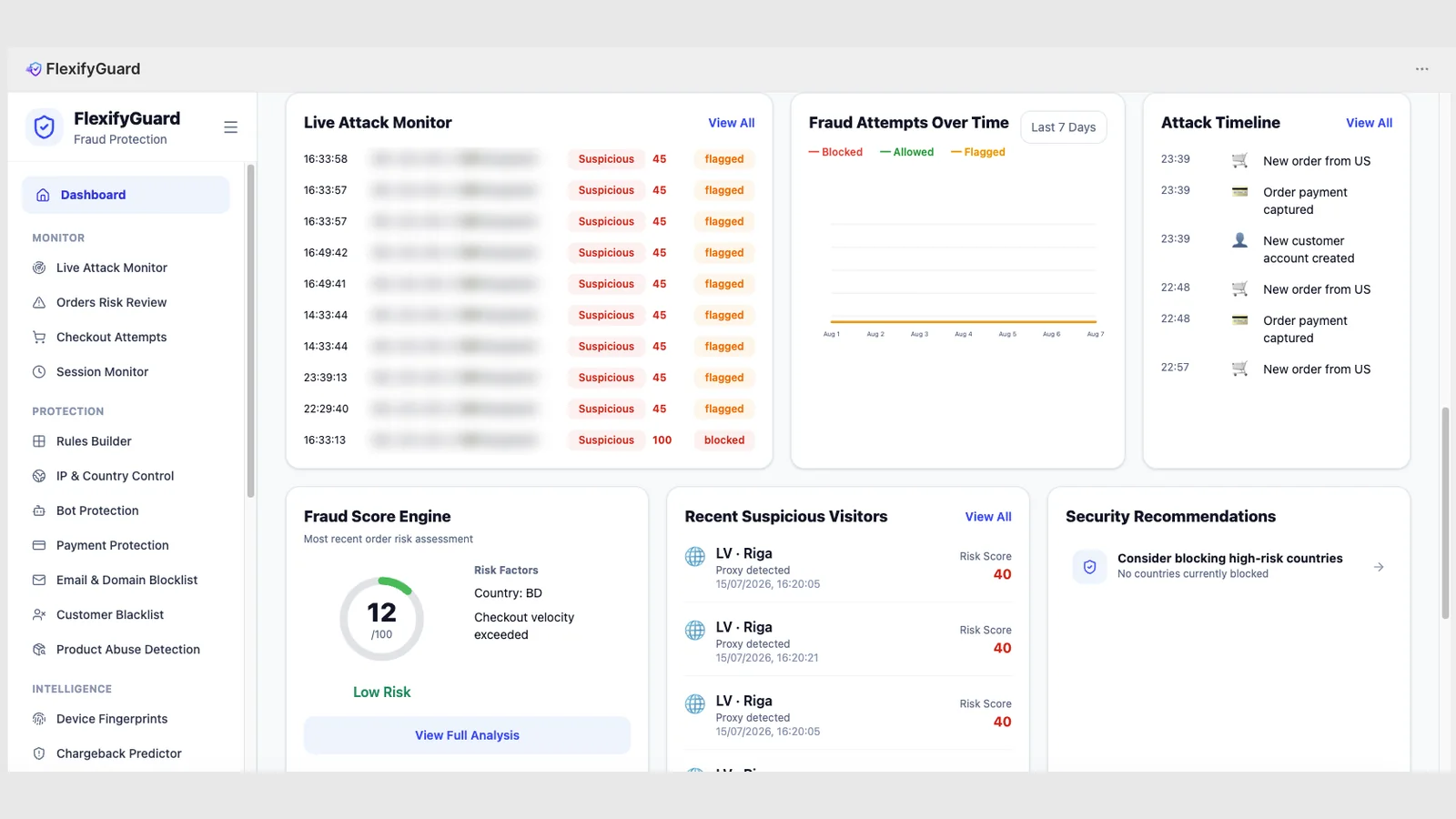
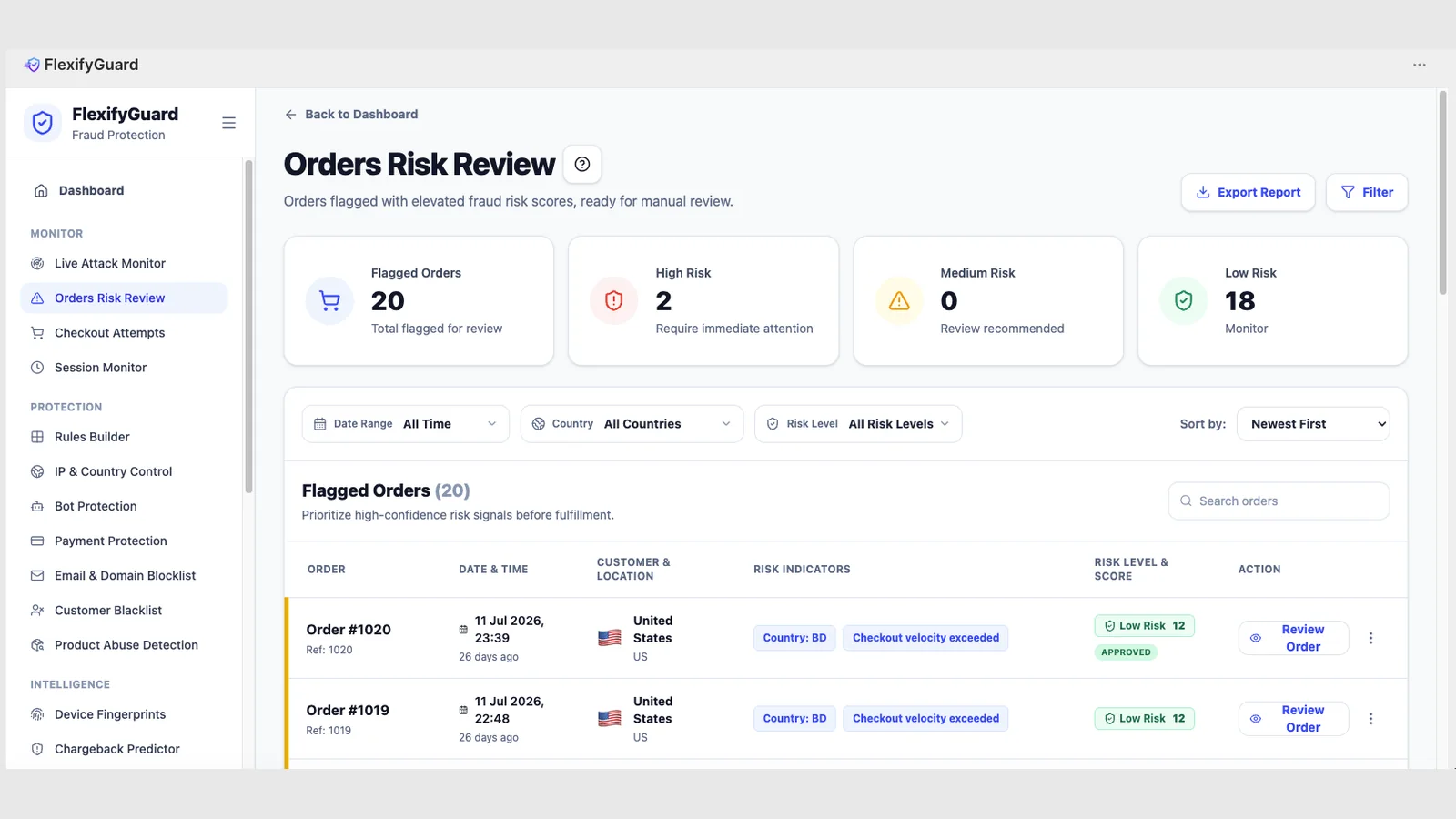
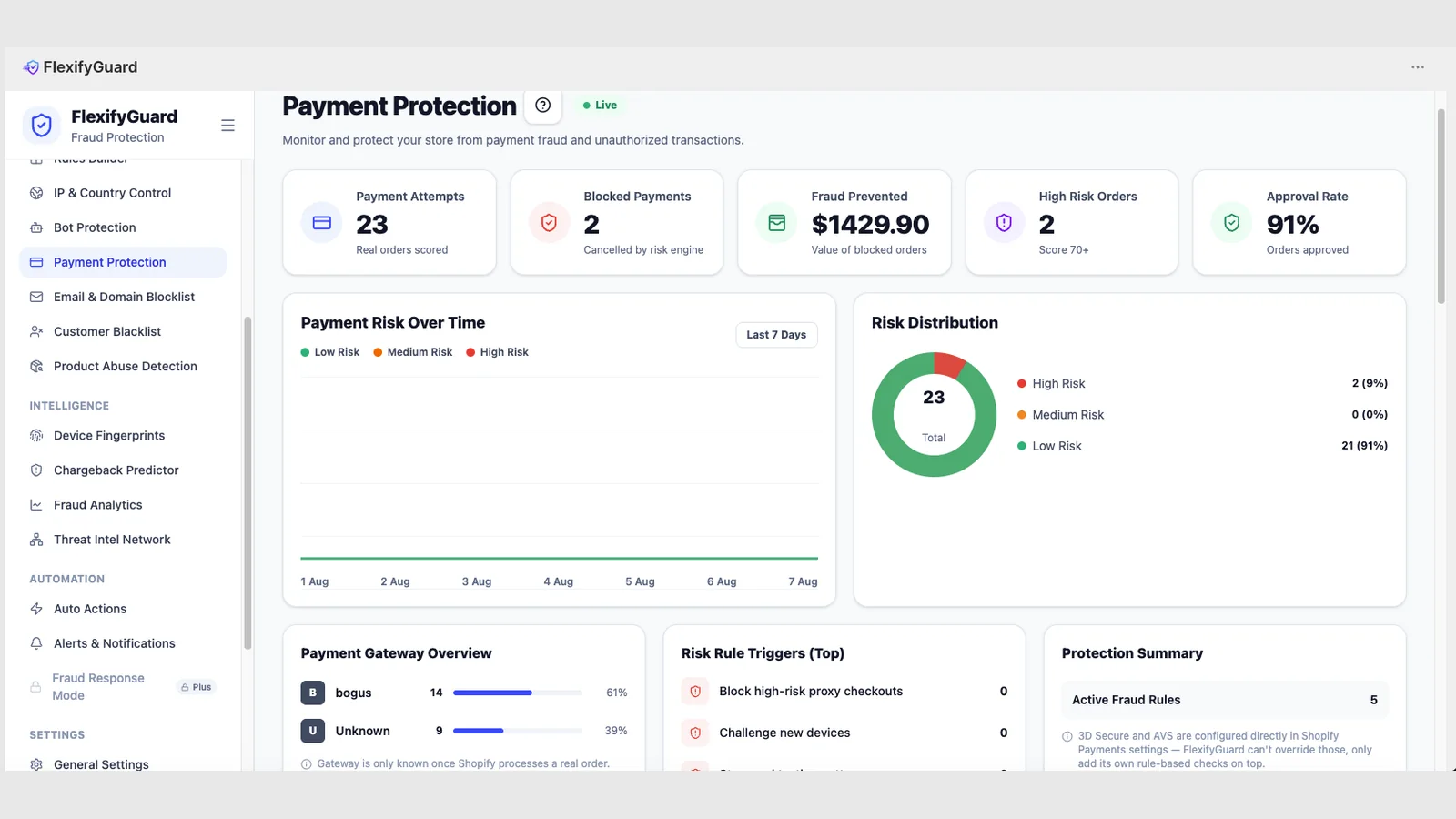
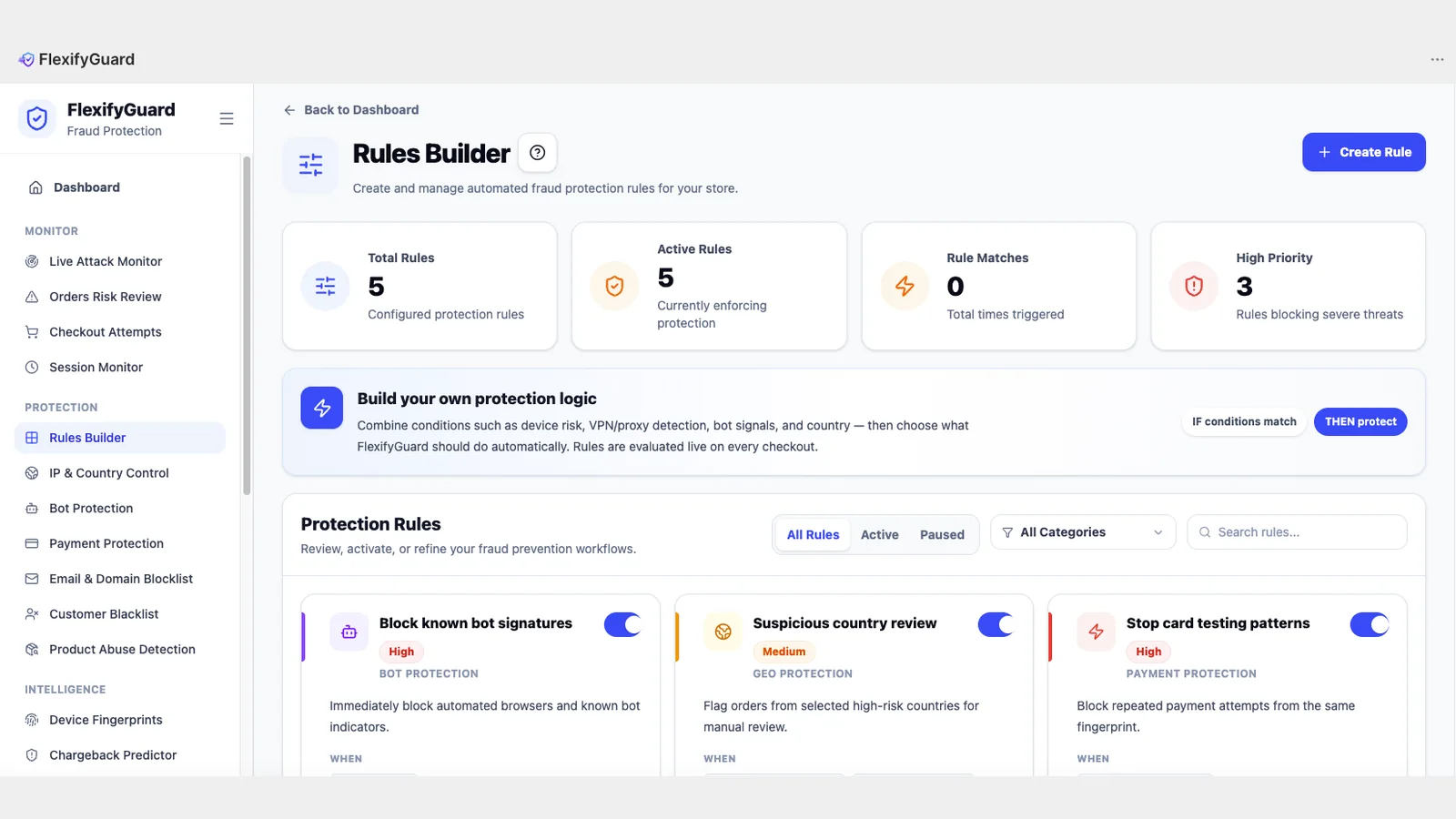
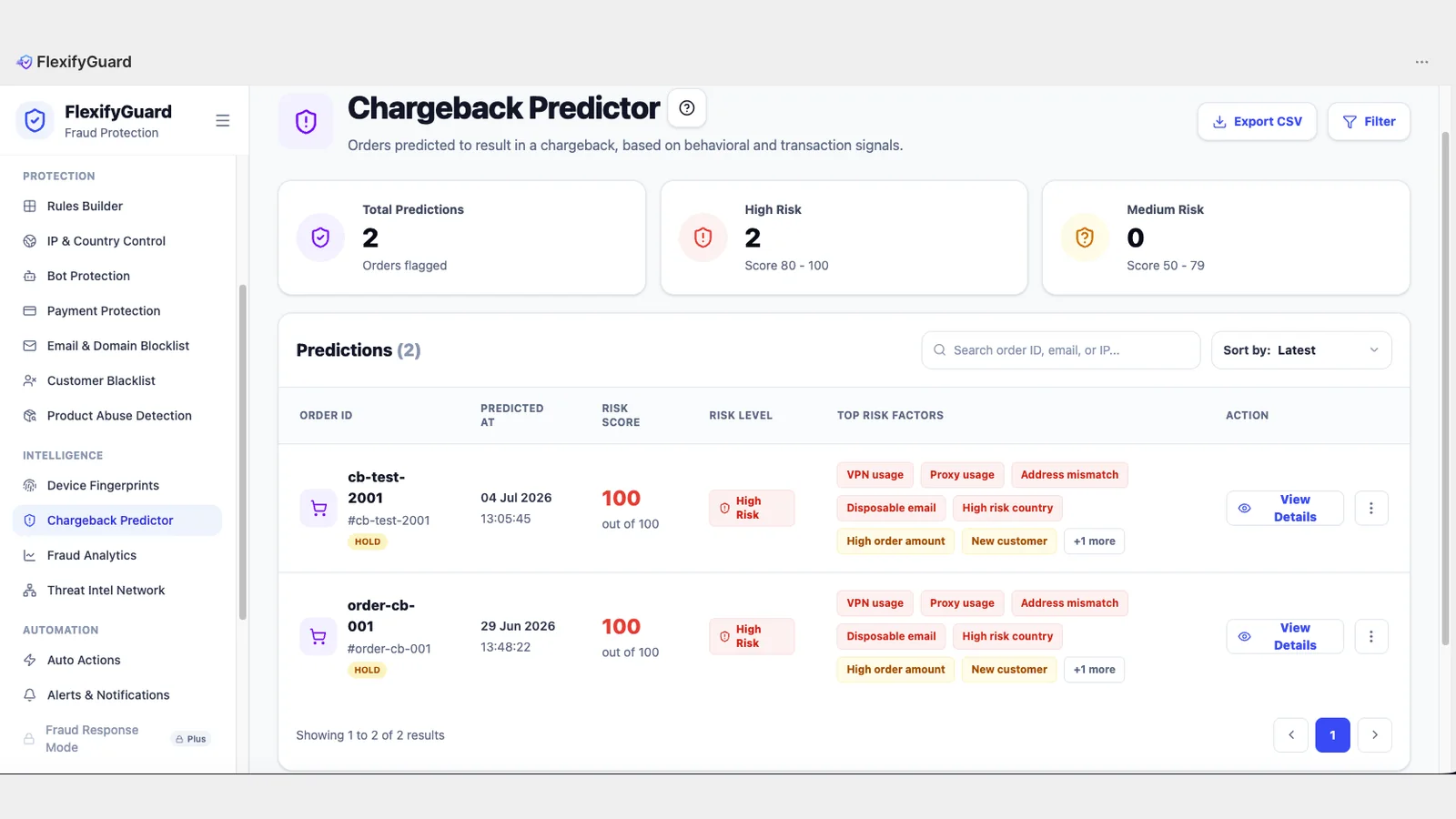
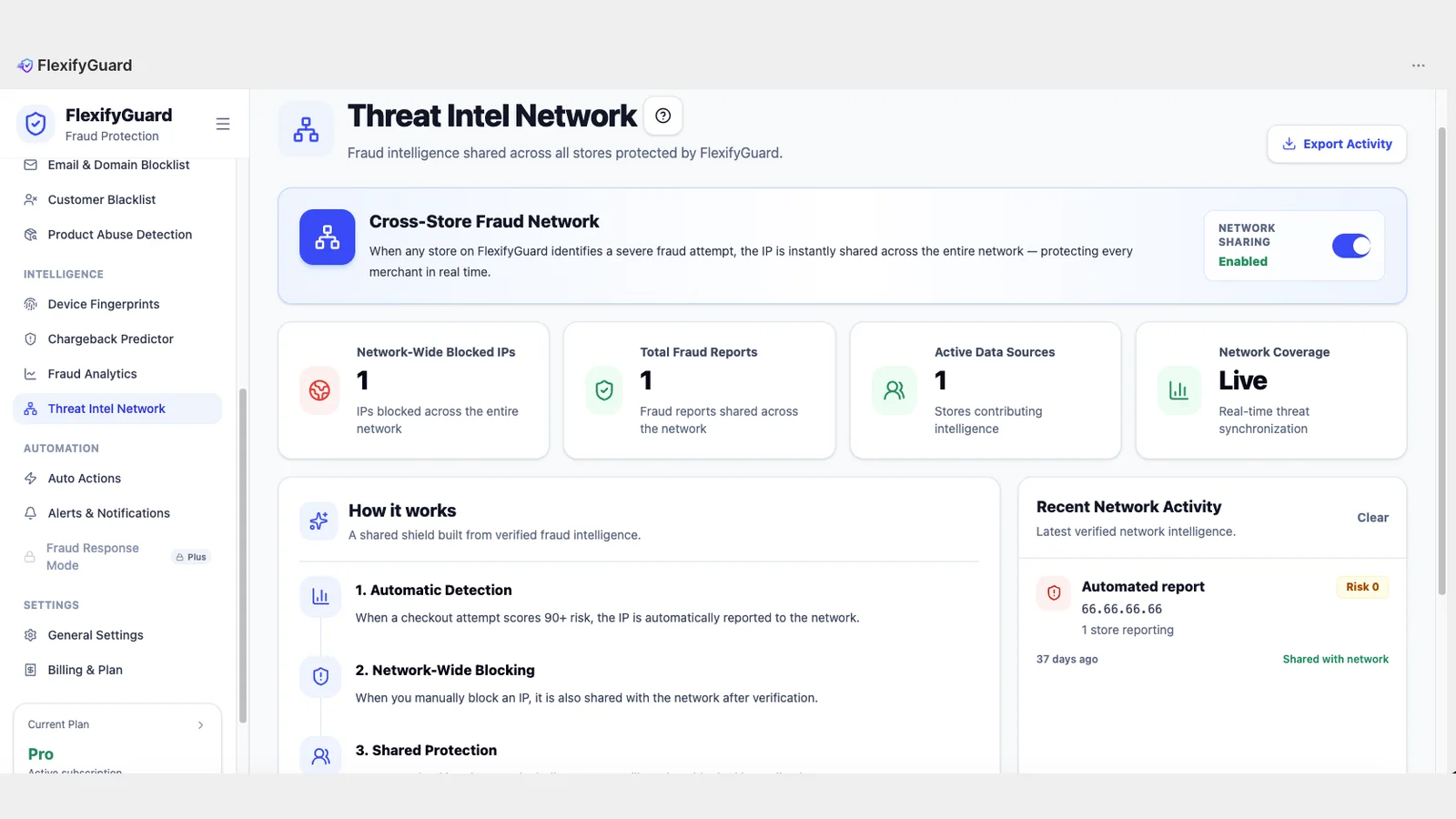
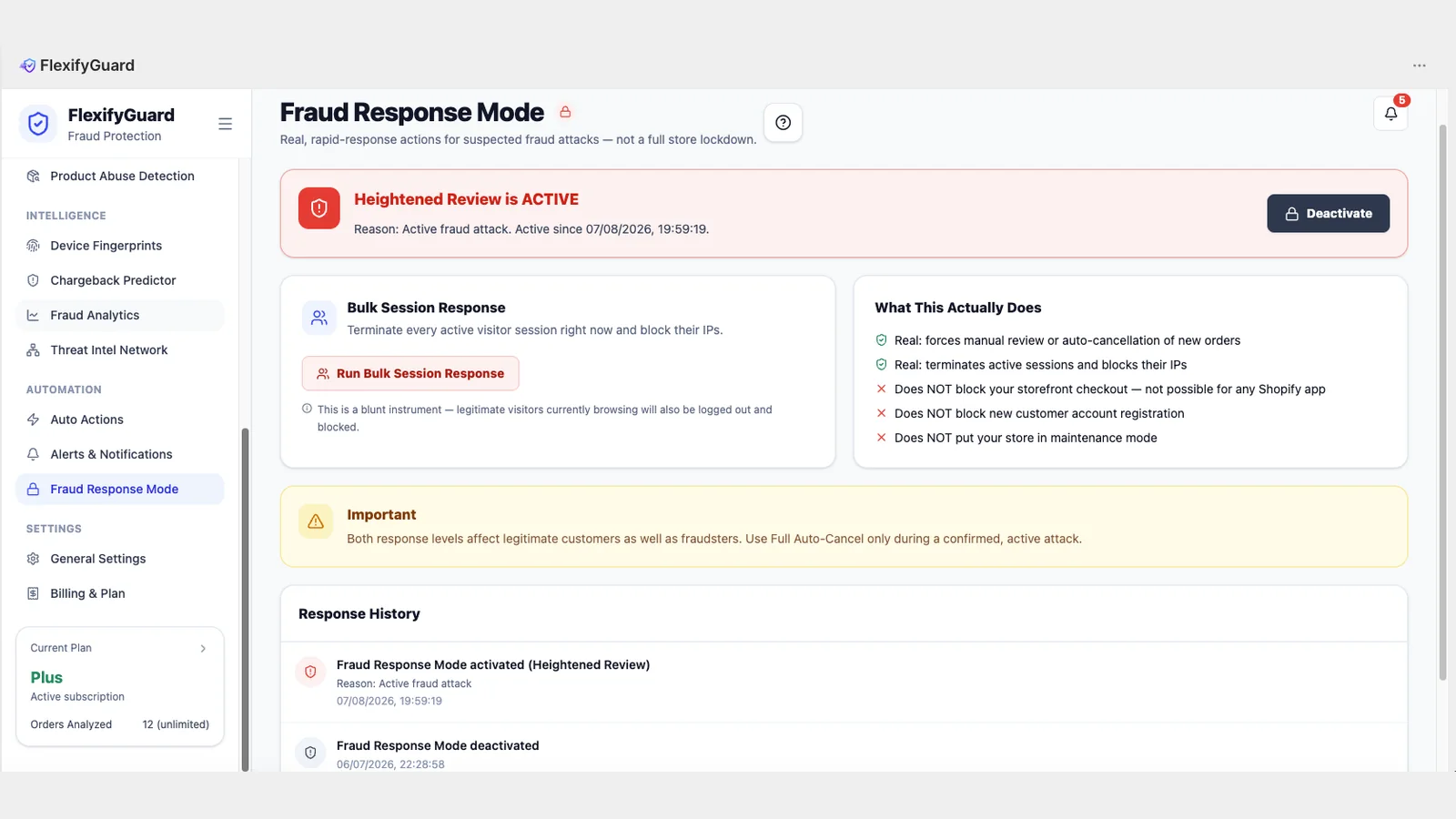
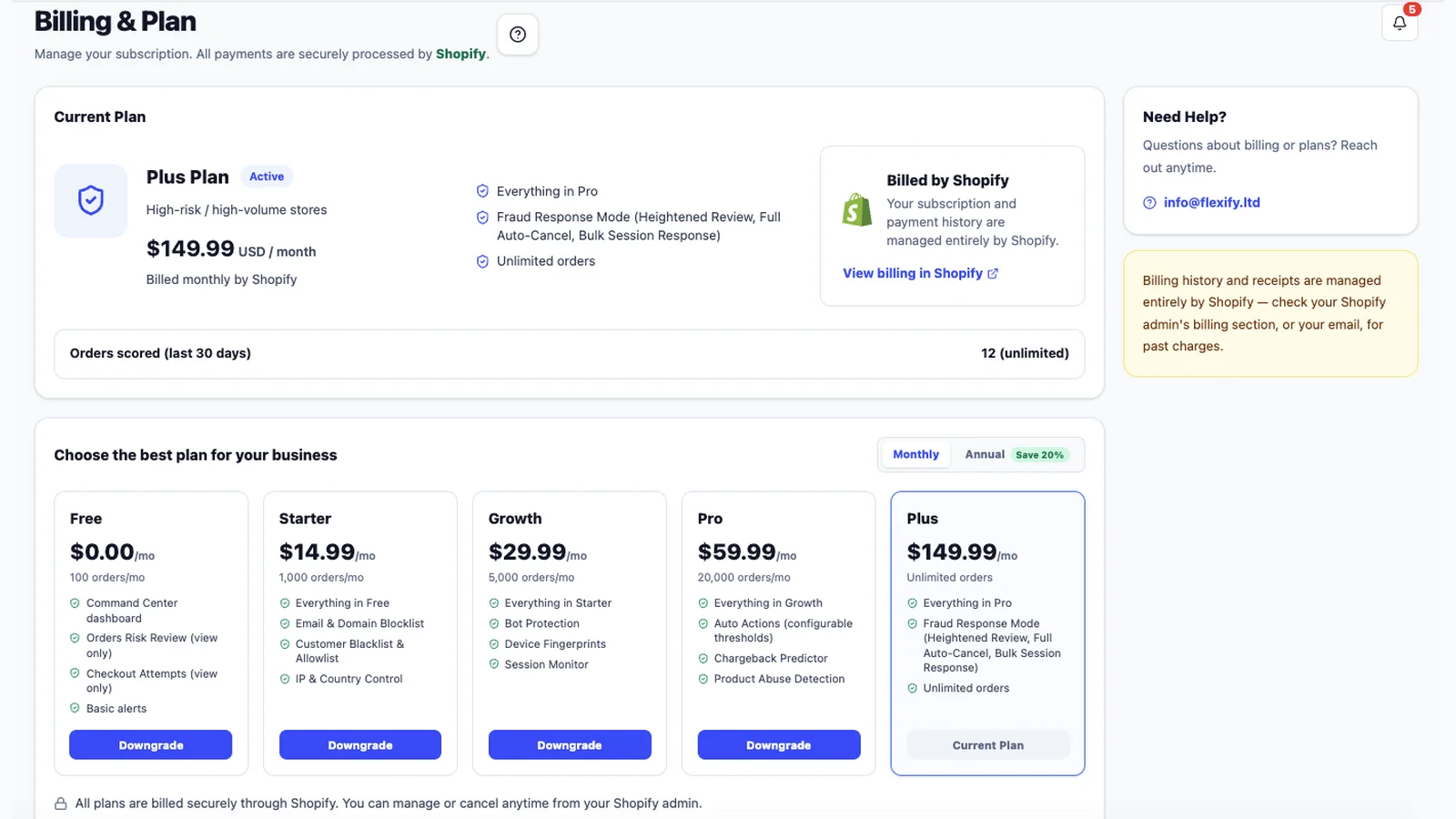
First three are product artwork. The rest are screens from the app — test-store data, with an IP address and one email domain blurred for privacy.
Four steps, running on every order. The thresholds are yours to set.
Shopify fires the orders/create webhook the moment a customer completes checkout.
Device fingerprint, VPN and proxy detection, bot signals, country, checkout velocity, email reputation and your own rules combine into one score out of 100.
Flag at 40, review at 60, cancel at 85 by default. Four presets ship: Learning, Standard, Strict and Custom.
Cancel via the Admin API, hold for manual review, or allow — within seconds, before fulfilment.
Fraud tooling is only useful if you can see what it did and why. FlexifyGuard splits into monitoring, active protection, the intelligence behind the scoring, and the automation that acts on it.
What is happening on your store right now, and what already got through.
The rules and lists that decide which orders get cancelled.
The signals behind every score — device, behaviour and the wider network.
What happens without you, and how loudly it tells you.
These are screens from the app. Where a module has a limit, the app states it — and so does this page.

Combine device risk, VPN and proxy detection, bot signals and country into IF/THEN rules evaluated live on every checkout. Ships with working defaults for bot signatures, suspicious countries and card-testing patterns.

Detects headless browsers, Selenium and Puppeteer automation, with a JavaScript challenge and rate limiting for suspicious IPs. This is the card-testing defence, because card testing is automated by definition.

Scores real payment attempts and cancels those that fail. The panel is clear that 3D Secure and AVS live in Shopify Payments and FlexifyGuard cannot override them — it adds rule-based checks on top rather than replacing them.

Block single IPs, CIDR ranges or whole countries. Each block can optionally be shared with the FlexifyGuard network so other merchants are protected from the same address.

The panel states plainly that a blocklisted address cannot be stopped from reaching Shopify checkout. FlexifyGuard detects the match once the order lands, cancels within seconds, and alerts you.

Matches on email, phone and Shopify customer ID. An allowlisted customer always wins — even over a blacklist match — so a good customer cannot be caught by a broad rule.

Scans your catalogue for policy-violating listings, with an AI second pass on ambiguous matches. The app notes that counterfeit and copyright flags are language-pattern indicators, not legal determinations, and nothing is removed without your review.

Tracks unique devices across visits even when the IP or email changes, and marks VPN and proxy users — catching the repeat offender who assumes a new email is a new identity.

When a checkout scores 90 or above on any store running FlexifyGuard, that IP is reported and blocked across the whole network. Manual blocks are shared after verification, so protection improves as more stores join.

The three thresholds that classify every order, plus a switch for whether risk score alone can cancel without a blocklist match.

Learning observes and rarely acts. Standard is the balanced default. Strict reviews and cancels aggressively. Custom hands you the numbers. Start on Learning while you calibrate.

For a live attack: forces review or auto-cancellation and terminates active sessions. The panel lists what it does not do, and calls Bulk Session Response a blunt instrument that logs out legitimate browsers too.
Four subscription tiers, billed monthly or yearly. Storage and user limits rise with each tier; the full comparison and current terms live on the product site.

Prices in US dollars, as published on the FlexifyGuard site. See full FlexifyGuard pricing and plan limits.
No, and no Shopify app can — Shopify controls the checkout page. FlexifyGuard scores each order the moment it is created and cancels high-risk ones within seconds through Shopify's Admin API, before fulfilment. Any app claiming to block checkout outright is describing something the platform does not permit.
Card testing is automated, so the defence is bot detection. FlexifyGuard identifies headless browsers, Selenium and Puppeteer automation, applies a JavaScript challenge and rate-limits suspicious IPs. Repeated payment attempts from one device fingerprint are blocked by rule, and offending IPs are shared across the network.
It goes to Orders Risk Review with the triggering risk factors listed, so you decide. You control all three thresholds, and an allowlisted customer bypasses fraud scoring entirely, even over a blacklist match. The Learning preset observes without acting while you calibrate.
Shared fraud intelligence across every store running FlexifyGuard. When a checkout scores 90 or above anywhere on the network, that IP is reported and blocked for all protected merchants in real time. Manual blocks are shared after verification, so protection improves as the network grows.
No, it runs alongside it. 3D Secure and AVS are configured in Shopify Payments and FlexifyGuard cannot override them. It adds rule-based checks, device fingerprinting, bot detection and network intelligence on top of what Shopify already provides.
There is a free plan covering 100 orders a month. Paid plans are $14.99, $29.99, $59.99 and $149.99 a month, with 20% off annual billing. Everything is billed through Shopify, so you manage or cancel it from your Shopify admin.
The team that wrote FlexifyGuard is the team that answers when you message. Start on the product site, or ask us which modules fit the way you already work.
We use essential cookies to make the site work. We would also like to set Google Analytics cookies to understand how the site is used, but only if you agree. You can change your mind at any time. Read our cookie policy.